
Reference
HX711 + Load Cell Weight Sensor Complete Guide
The HX711 is a 24-bit ADC purpose-built to amplify the tiny signal from a 4-wire load cell into something a microcontroller can read reliably. This guide covers the real wiring convention, which varies by manufacturer, and the calibration process every load cell genuinely needs, regardless of which specific one you bought.
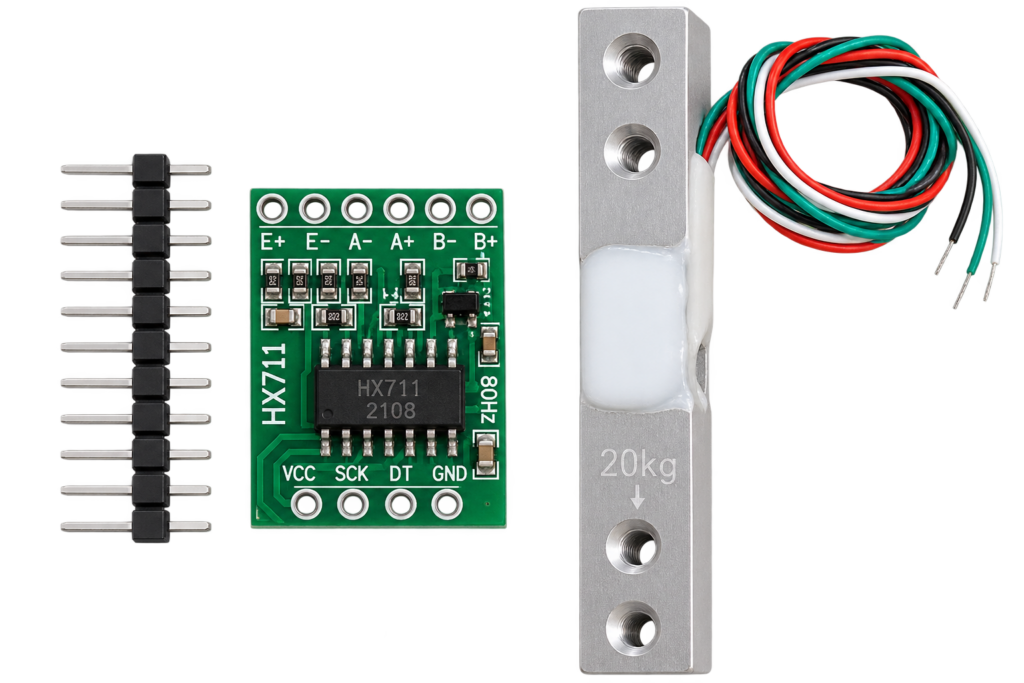
A load cell is a strain gauge that outputs a microvolt-scale signal proportional to force, far too small and noisy for a microcontroller’s ADC to read directly. The HX711 is a dedicated 24-bit precision ADC that amplifies and digitizes that signal, then hands your microcontroller a clean number over a simple 2-wire protocol. This guide covers the HX711 module itself, not a specific load cell’s exact capacity, load cells range from a few hundred grams to several tonnes, and the wiring/calibration process below is the same regardless of which capacity you bought.
Pinout
| Pin | Function |
|---|---|
| VCC | Power, 2.6V–5.5V |
| GND | Ground |
| DT (or DOUT) | Serial data output |
| SCK | Serial clock input |
| E+ | Load cell excitation positive, to the load cell’s red wire |
| E− | Load cell excitation negative, to the load cell’s black wire |
| A+ | Load cell signal positive, to the load cell’s white wire |
| A− | Load cell signal negative, to the load cell’s green wire |
A 4-wire load cell’s color convention (red/black/white/green for excitation+/excitation−/signal+/signal−) is common but not universal, cheap load cells from different manufacturers sometimes swap white/green. If you accidentally swap the two signal wires, the reading just comes out with an inverted sign, harmless and fixable in your calibration factor, no need to re-wire.
Wiring to an ESP32
| HX711 Pin | ESP32 Pin |
|---|---|
| VCC | 3.3V |
| GND | GND |
| DT | GPIO4 |
| SCK | GPIO5 |
DT and SCK can be any two free GPIOs, this protocol is bit-banged, not a hardware peripheral.
Arduino code (HX711 library by Bogdan Necula)
#include "HX711.h"

#define DT_PIN 4
#define SCK_PIN 5

HX711 scale;

void setup() {
  Serial.begin(115200);
  scale.begin(DT_PIN, SCK_PIN);
  scale.set_scale();       // reset until you calculate a real factor, see below
  scale.tare();            // zero the scale with nothing on it
}

void loop() {
  if (scale.is_ready()) {
    Serial.print("Weight: ");
    Serial.print(scale.get_units(10)); // average of 10 readings
    Serial.println(" units");
  }
  delay(200);
}
Install “HX711” (by Bogdan Necula) via the Arduino Library Manager.
Calibration (the part every load cell actually needs)
A load cell’s raw HX711 reading is meaningless until you calculate its calibration factor, and this step is unavoidable, every load cell, even two units of the exact same model, calibrates slightly differently.
- With nothing on the scale, call
scale.set_scale()(no argument) andscale.tare()to zero it. - Place an object of known weight (a kitchen scale, a labeled weight, anything with a known real mass) on the load cell.
- Read the raw value with
scale.get_units(10). - Calculate the calibration factor:
raw_reading / known_weight. - Hard-code that factor into
scale.set_scale(your_factor)in your real sketch.
Practical Applications
- DIY kitchen/postal scales: the most common hobby use case.
- Filament-level monitoring: track remaining 3D-printer filament by weight.
- Plant/garden watering automation: trigger watering based on soil/pot weight.
- Inventory/stock-level sensing: detect when a bin or container needs refilling.
Conclusion
The HX711 turns a load cell’s tiny, noisy analog signal into a clean, calibratable digital reading over a simple 2-wire bit-banged protocol, pairing easily with an ESP32 on any two free GPIOs.
Related
 Guide
ATtiny 0/1/2-Series Pinout
The complete pin reference for Microchip’s modern ATtiny 0/1/2-series: true USART, SPI and I2C peripherals, and single-wire UPDI programming instead of classic ISP.
Read more
Guide
ATtiny 0/1/2-Series Pinout
The complete pin reference for Microchip’s modern ATtiny 0/1/2-series: true USART, SPI and I2C peripherals, and single-wire UPDI programming instead of classic ISP.
Read more
 Reference
The Ultimate Guide to the SHT Sensor Series
Sensirion's SHT2x/3x/4x family are factory-calibrated I2C temperature and humidity sensors with low drift and fast response. This guide compares the three series, covers wiring an SHT31 to an ESP32, and helps pick the right model for accuracy, power budget or outdoor use.
Read more
Reference
The Ultimate Guide to the SHT Sensor Series
Sensirion's SHT2x/3x/4x family are factory-calibrated I2C temperature and humidity sensors with low drift and fast response. This guide compares the three series, covers wiring an SHT31 to an ESP32, and helps pick the right model for accuracy, power budget or outdoor use.
Read more
 Reference
NodeMCU-ESP32-C2 Pinout
The pin reference for the NodeMCU-style ESP32-C2 development board: the ESP8684-WROOM-02 module, its exposed GPIOs, and how to flash it over USB-C.
Read more
Reference
NodeMCU-ESP32-C2 Pinout
The pin reference for the NodeMCU-style ESP32-C2 development board: the ESP8684-WROOM-02 module, its exposed GPIOs, and how to flash it over USB-C.
Read more
More guides
Keep building.
From ESP32 HomeKit accessories to Arduino and ATtiny reference guides, there’s more where this came from.
All guides