
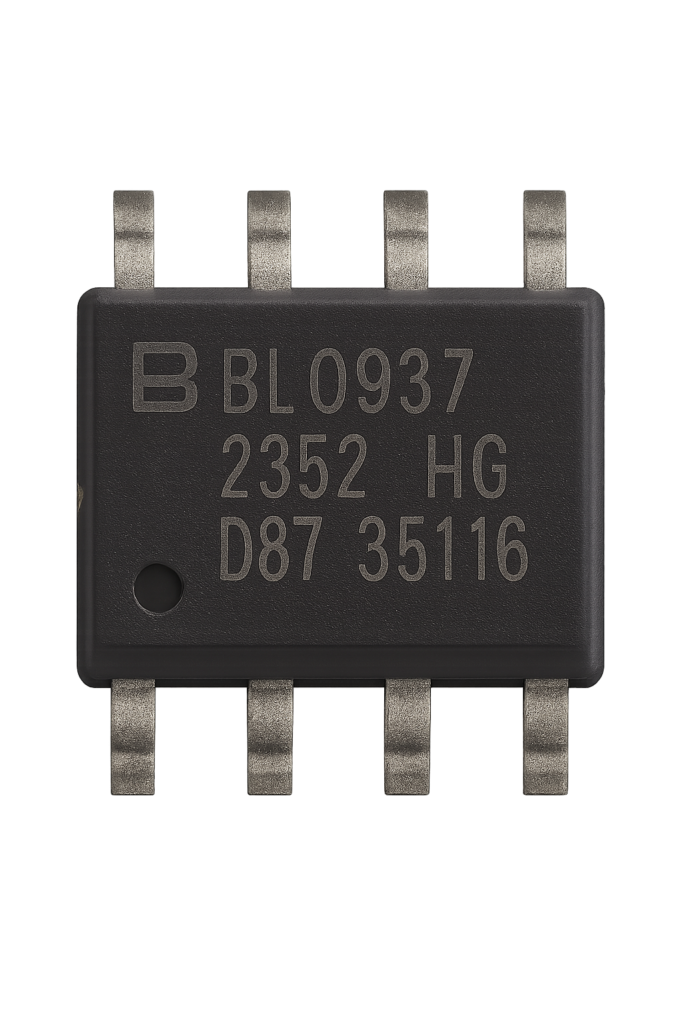
The BL0937 is a highly integrated, cost-effective single-phase energy metering IC designed for modern smart sockets, power strips, and intelligent appliances. Engineered for accuracy, stability, and simplicity, it enables precise measurement of active power, voltage RMS, and current RMS using only a handful of external components. Whether you are a hobbyist building a smart plug or an engineer designing a certified energy-monitoring product, the BL0937 provides a reliable and elegant solution.
What is the BL0937?
Energy Meter IC
At the heart of the BL0937 lies a dedicated single-phase energy measurement engine developed by Shanghai Belling. The chip integrates two high-accuracy Sigma-Delta ADCs, a precision voltage reference, digital signal processing (DSP), and a digital-to-frequency converter. Together, these blocks calculate active power, current RMS, and voltage RMS with excellent linearity and long-term stability.
Integrated Oscillator
Unlike many metering solutions, the BL0937 includes an internal ~2 MHz oscillator. This eliminates the need for an external crystal, reducing BOM cost and simplifying PCB layout while maintaining measurement accuracy.
Compact SOP-8 Package
Housed in a small SOP-8 package, the BL0937 is ideal for compact designs such as wall sockets, smart adapters, and embedded power modules.
Designed for Accurate Power Measurement
The BL0937 is optimized for real-world AC measurement scenarios and offers a robust feature set:
- ±0.5 % typical active power accuracy over a 2500:1 dynamic range
- Independent voltage RMS and current RMS measurement
- Wide current range (from mA up to tens of amperes with a shunt)
- On-chip voltage reference (1.218 V typical)
- On-chip anti-creep protection
- Fast over-current detection
- Low power consumption (≈ 6 mW typical at 3.3 V)
- Simple pulse-output interface for easy MCU integration
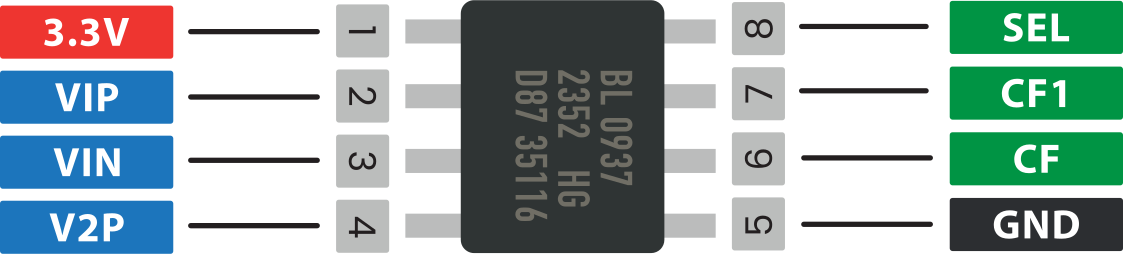
BL0937 Pinout – Fundamentals
The BL0937 uses an 8-pin SOP package. Each pin has a clearly defined role, optimized for energy measurement applications.
Power and Ground
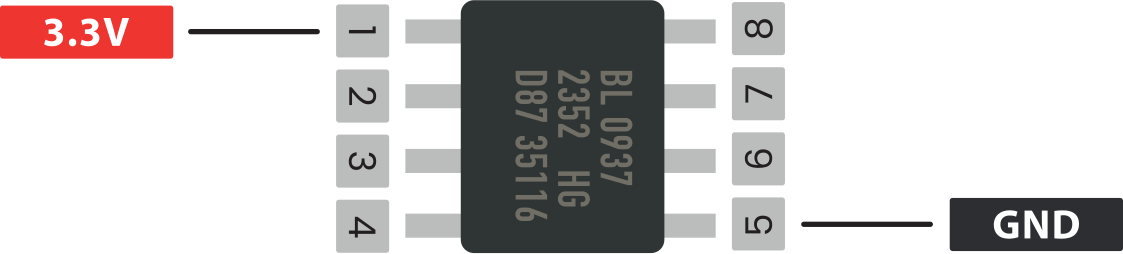
VDD (Pin 1)
Power supply input. Operates from a single 3.0 V–3.6 V supply (3.3 V typical). Proper decoupling close to the pin is essential for stable measurements.
GND (Pin 5)
Ground reference for both analog and digital sections.
Current Measurement Channel
IP (Pin 2) & IN (Pin 3)
Differential inputs for the current channel. These pins connect across a low-value shunt resistor (typically 1 mΩ).
- Maximum differential input: ±50 mV (peak)
- High input impedance (~370 kΩ)
- Designed for precise RMS and power calculations BL0937_V1.02_en

Voltage Measurement Channel
VP (Pin 4)
Voltage channel input. Typically connected to a resistor divider from the AC mains.
- Maximum differential input: ±200 mV (peak)
- High input impedance (~370 kΩ)
This channel provides the voltage waveform required for both RMS and active power computation.

Digital Outputs and Control
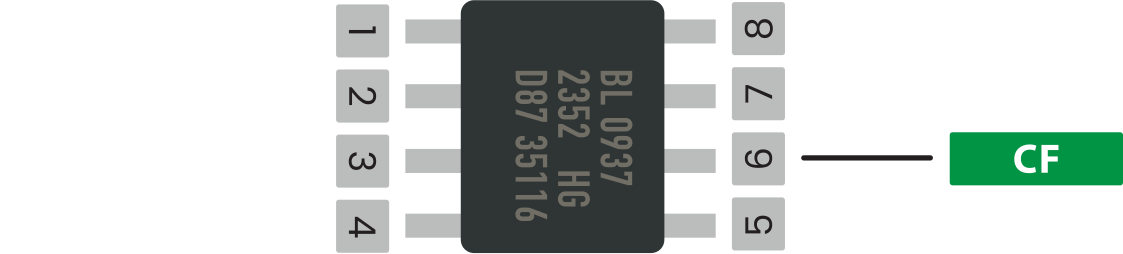
CF (Pin 6) – Active Power Output
High-frequency pulse output proportional to active power.
- Fixed pulse width (~38 µs typical)
- Frequency increases with load power
- Also used as an over-current indicator (≈ 6.7 kHz output when triggered)
CF1 (Pin 7) – RMS Output
Multiplexed RMS output:
- SEL = 0: CF1 outputs current RMS pulses
- SEL = 1: CF1 outputs voltage RMS pulses
Pulse width is fixed, frequency proportional to the selected RMS value.
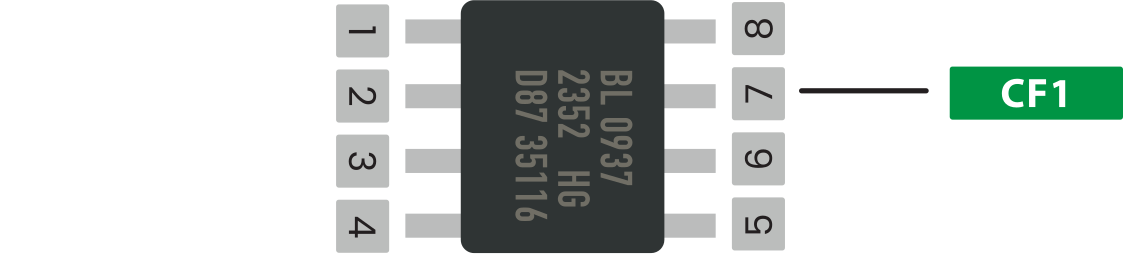
SEL (Pin 8)
Selects whether CF1 represents current RMS or voltage RMS. An internal pull-down ensures a default state if left unconnected.

How the BL0937 Measures Energy
The BL0937 calculates energy using true digital signal processing:
- Voltage and current waveforms are sampled by two independent Sigma-Delta ADCs.
- The DSP multiplies instantaneous voltage and current samples to compute instantaneous power.
- A low-pass filter extracts the real (active) power component.
- Results are accumulated and converted into pulse frequencies on CF and CF1.
This frequency-based interface allows even low-cost microcontrollers to measure power and energy accurately by counting pulses over time BL0937_V1.02_en.
Typical Application Circuit
A standard BL0937 application includes:
- A resistive shunt for current sensing
- A resistor divider for voltage sensing
- Minimal RC filtering for noise suppression
- Direct connection of CF, CF1, and SEL to MCU GPIO pins
The MCU measures pulse frequency or period to calculate:
- Active power (from CF)
- Current RMS or voltage RMS (from CF1)
This architecture removes the need for high-resolution ADCs on the microcontroller.
Best Practices and Common Mistakes
To get the best performance from the BL0937, follow these guidelines:
- Use a precision, low-TC shunt resistor for current sensing.
- Keep analog traces short and symmetrical.
- Place decoupling capacitors close to VDD.
- Avoid noisy digital routing near IP/IN/VP pins.
- Calibrate the system using known loads.
- Ensure proper isolation and safety when working with mains voltage.
Interfacing the BL0937 with a Microcontroller
The BL0937 is MCU-agnostic and works well with ESP32, STM32, AVR, and other controllers.
Typical MCU Tasks:
- Measure CF pulse frequency → active power / energy
- Measure CF1 pulse frequency → voltage RMS or current RMS
- Toggle SEL if both RMS values are required
Because outputs are digital pulses, firmware remains simple, robust, and timing-based.
Conclusion: Simple, Accurate, and Purpose-Built
The BL0937 is a masterclass in application-specific IC design. By focusing solely on single-phase energy measurement, it delivers excellent accuracy, low cost, and minimal external requirements. Its pulse-based interface bridges the analog world of AC power and the digital world of microcontrollers with elegance and reliability.
If you are designing smart sockets, power strips, or energy-aware appliances, mastering the BL0937 pinout and operation will give you a strong, proven foundation.