
Reference
The Complete Guide to the HLK-LD2450 24GHz Multi-Target Tracking Radar Module
The LD2450 is Hi-Link's multi-target mmWave radar: where the already-published LD2410 only tells you someone is present, the LD2450 tracks up to three people at once with real X/Y position and speed. This guide covers its real UART protocol, wiring, and when you actually need position tracking over simple presence.
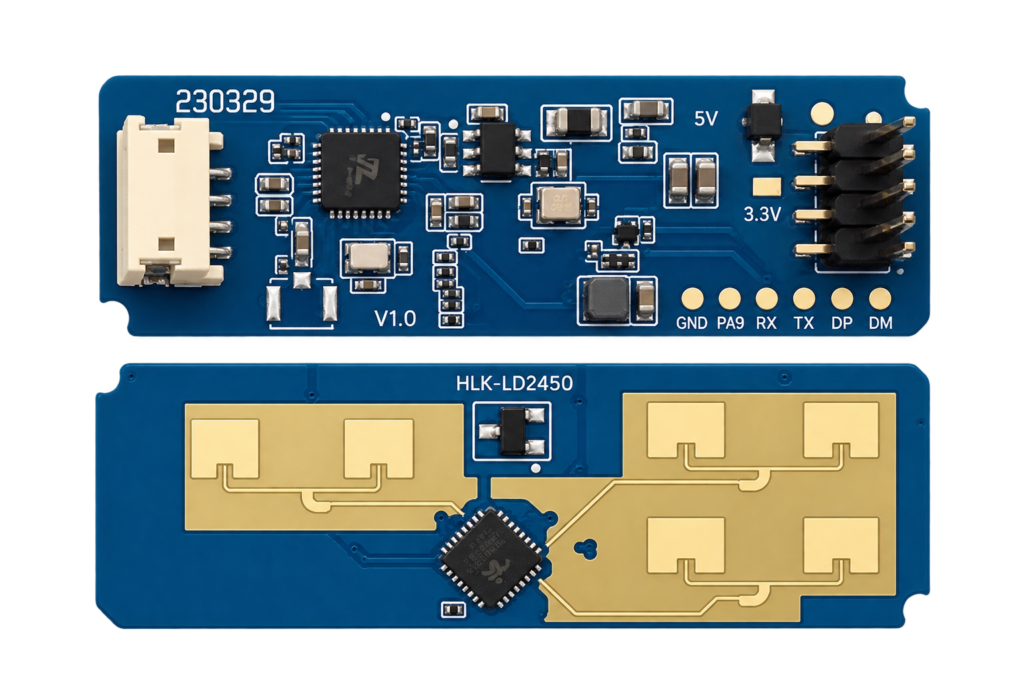
The HLK-LD2450 is a 24GHz FMCW (frequency-modulated continuous-wave) millimeter-wave radar module from Shenzhen Hi-Link, the sibling of the already-published HLK-LD2410. Where the LD2410 answers a yes/no “is someone there” question, the LD2450 tracks up to three separate moving targets simultaneously, each with its own X/Y coordinate and speed, streamed continuously over UART.
LD2410 or LD2450: which do you need?
| LD2410 | LD2450 | |
|---|---|---|
| Reports | Presence + rough distance gate, single zone | X/Y position + speed, per target, up to 3 targets |
| Best for | “Turn on the light when someone’s in the room” | “Where in the room is each person, and are they moving” |
| Output | Simple presence/distance frames | Binary coordinate frames per target, 10 frames/sec |
If you only need occupancy detection, the simpler LD2410 is cheaper and easier to integrate. Reach for the LD2450 when you need to know where someone is in a room, count multiple people, or detect direction of movement.
Specifications and Pinout
| Spec | Value |
|---|---|
| Frequency band | 24GHz–24.25GHz (FMCW) |
| Power supply | 5V DC, >200mA |
| Detection range | ~6m |
| Detection angle | ±60° |
| Data refresh rate | 10Hz (10 frames/second) |
| Max simultaneous targets | 3 |
| UART baud rate (fixed) | 256000, 1 stop bit, no parity |
| Pin | Function |
|---|---|
| VCC | 5V |
| GND | Ground |
| TX | Radar’s UART transmit → MCU RX |
| RX | Radar’s UART receive ← MCU TX |
| OT1 | Optional presence output pin (open-drain) |
Wiring to an ESP32
The module needs a genuine 5V supply (not 3.3V) but its UART logic level is 3.3V-safe for direct connection to an ESP32’s hardware UART. Cross TX/RX between the two devices.
| LD2450 Pin | ESP32 Pin |
|---|---|
| VCC | 5V (VIN) |
| GND | GND |
| TX | GPIO16 (RX2) |
| RX | GPIO17 (TX2) |
Arduino code (HLK-LD2450 library by RBEGamer)
#include <HardwareSerial.h>
#include <LD2450.h>

HardwareSerial radarSerial(2);
LD2450 radar;

void setup() {
  Serial.begin(115200);
  radarSerial.begin(256000, SERIAL_8N1, 16, 17);
  radar.begin(radarSerial);
}

void loop() {
  radar.read();
  for (int i = 0; i < 3; i++) {
    if (radar.getTargetActive(i)) {
      Serial.printf("Target %d: x=%dmm y=%dmm speed=%dcm/sn",
        i, radar.getTargetX(i), radar.getTargetY(i), radar.getTargetSpeed(i));
    }
  }
  delay(100);
}
The exact method names vary slightly between the several community LD2450 libraries (RBEGamer/HLK-LD2450, darkjumpy/HLK-LD2450_Arduino_Library, Fiooodooor/HLK-LD245X all exist), check the specific library’s own examples, the wiring and 256000-baud UART protocol are the same regardless of which one you pick.
Practical Applications
- Room occupancy counting: track up to 3 people moving through a space.
- Smart lighting zones: turn on only the light near the tracked X/Y position, not the whole room.
- Fall/motion-pattern detection: speed and position data over time can flag unusual movement.
- Privacy-preserving presence: no camera involved, useful where a camera would raise privacy concerns.
Conclusion
The LD2450 gives you real multi-target position tracking that a simple presence sensor like the LD2410 can’t, at the cost of a more involved binary UART protocol. Pair it with an ESP32’s hardware UART for reliable 256000-baud framing.
Related
 Reference
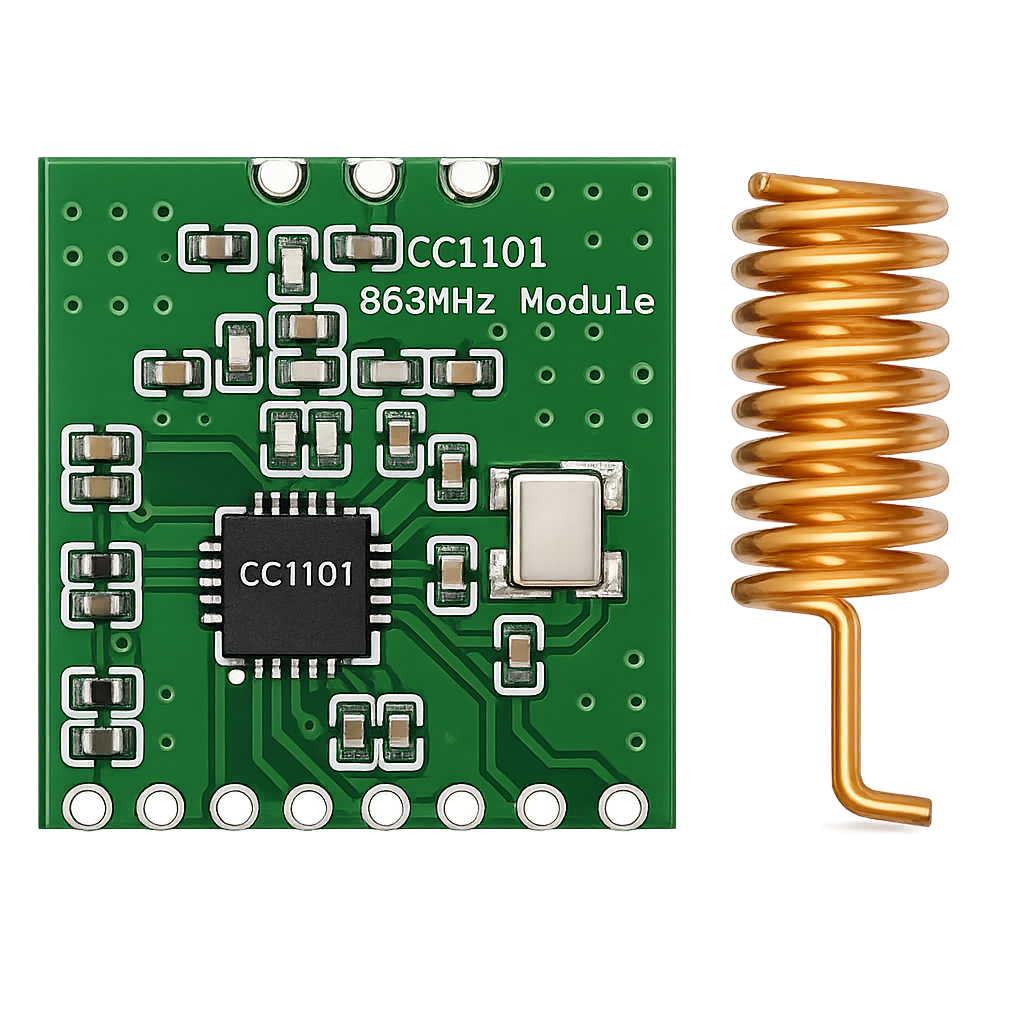
CC1101 868MHz SPI RF Module – Complete Guide
A programmable sub-GHz transceiver for the 868 MHz ISM band with hardware packet handling, CRC and RSSI built in. This guide covers the pinout, ESP32 wiring, ESP-IDF SPI setup, register configuration, and how it compares to LoRa.
Read more
Reference
CC1101 868MHz SPI RF Module – Complete Guide
A programmable sub-GHz transceiver for the 868 MHz ISM band with hardware packet handling, CRC and RSSI built in. This guide covers the pinout, ESP32 wiring, ESP-IDF SPI setup, register configuration, and how it compares to LoRa.
Read more
 Reference
NeoPixels (WS2812B) – Complete Guide
Individually addressable RGB LEDs that need just one data pin to control hundreds of LEDs, each with its own 24-bit color. This guide covers the WS2812B family, wiring to an ESP32-C6 SUPER MINI, power budgeting, and ESP-IDF/Arduino example code.
Read more
Reference
NeoPixels (WS2812B) – Complete Guide
Individually addressable RGB LEDs that need just one data pin to control hundreds of LEDs, each with its own 24-bit color. This guide covers the WS2812B family, wiring to an ESP32-C6 SUPER MINI, power budgeting, and ESP-IDF/Arduino example code.
Read more
 Guide
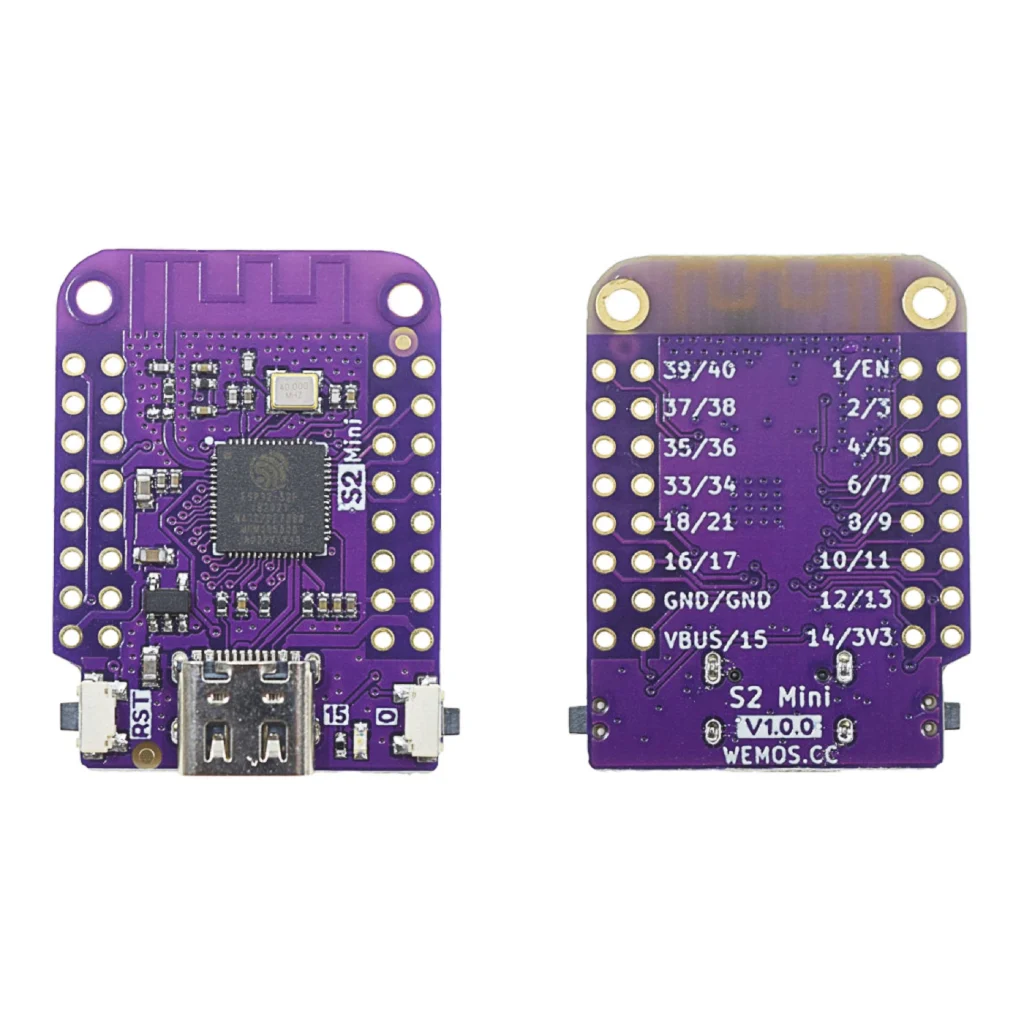
ESP32-S2 Mini Pinout
The complete pin reference for the WEMOS/Lolin S2 Mini: native USB, 14 capacitive touch pins, and no Bluetooth at all.
Read more
Guide
ESP32-S2 Mini Pinout
The complete pin reference for the WEMOS/Lolin S2 Mini: native USB, 14 capacitive touch pins, and no Bluetooth at all.
Read more
More guides
Keep building.
From ESP32 HomeKit accessories to Arduino and ATtiny reference guides, there’s more where this came from.
All guides