
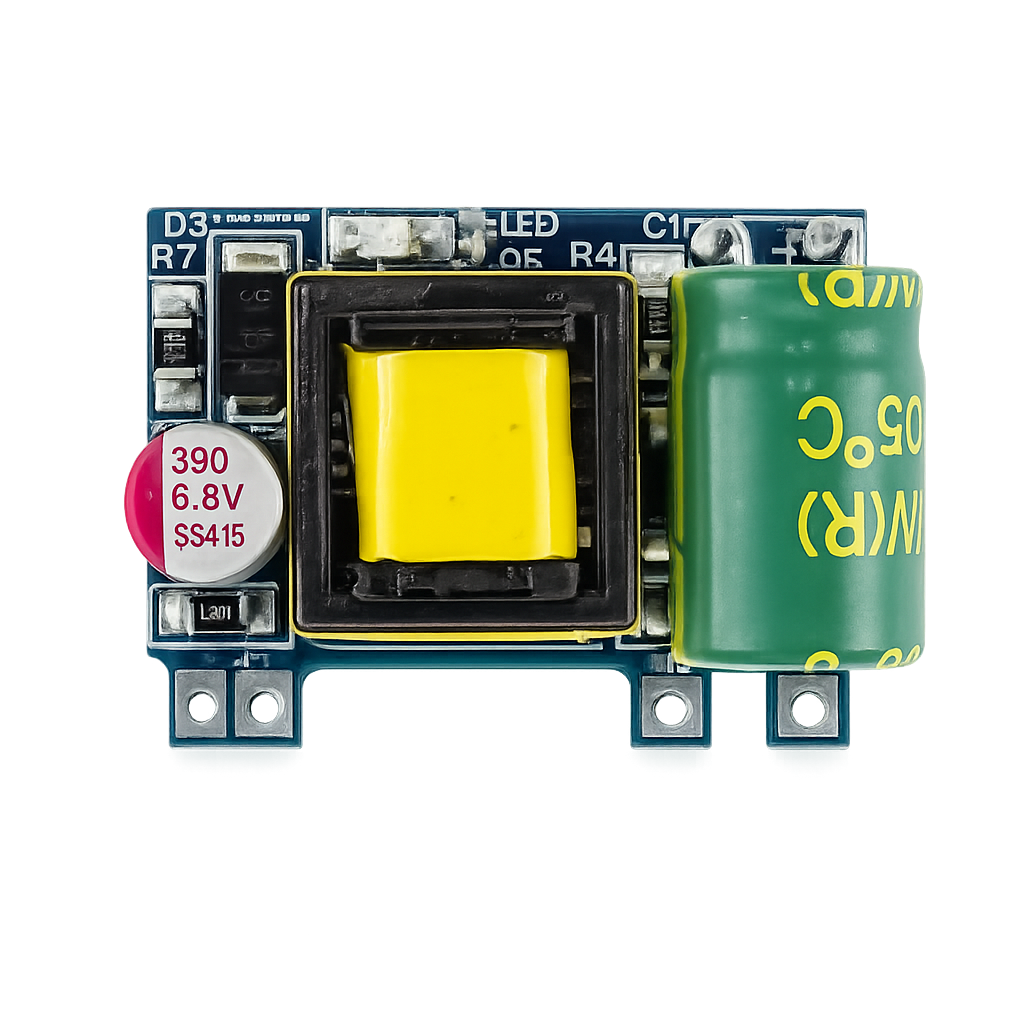
The JL-AD3W-HT-V3 is a compact AC-to-DC power supply module commonly found in low-cost embedded electronics, IoT devices, and DIY projects. It converts mains voltage directly into a regulated low-voltage DC output, typically 5 V, making it a popular alternative to bulky wall adapters or external power bricks. This article covers the JL-AD3W-HT-V3 as a hardware component: what it is, how it works, electrical characteristics, pinout, usage guidelines, and important safety considerations.
What Is the JL-AD3W-HT-V3?
The JL-AD3W-HT-V3 is a small switch-mode power supply (SMPS) module designed to be mounted directly onto a PCB or wired into an enclosure. It accepts AC mains voltage and provides a low-voltage DC output suitable for powering microcontrollers, sensors, and small electronic circuits.
Unlike complete power adapters, this module:
- Has no external enclosure
- Exposes mains-connected pads
- Is intended for internal use only inside insulated products
Typical Electrical Specifications
Exact specifications may vary slightly depending on manufacturer and batch, but the most commonly observed parameters are:
| Parameter | Typical Value |
|---|---|
| Input Voltage | 100–240 VAC, 50/60 Hz |
| Output Voltage | 5 V DC |
| Max Output Power | ~3 W to 3.5 W |
| Max Output Current | ~0.6–0.7 A |
| Topology | Isolated switch-mode power supply |
| Efficiency | Moderate (budget SMPS design) |
⚠️ These modules are usually not precision-regulated laboratory supplies. Output voltage may sag slightly under load.
How the module Works
Internally, the JL-AD3W-HT-V3 uses a non-isolated primary switching stage with transformer isolation to convert high-voltage AC into low-voltage DC. The typical stages include:
- AC rectification
- High-voltage DC filtering
- High-frequency switching circuit
- Transformer isolation
- Secondary rectification and smoothing
Because it is a low-cost SMPS, output ripple and EMI noise are higher than on premium power modules.
Pinout and Connections
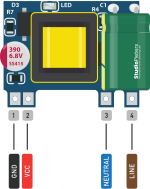
Most JL-AD3W-HT-V3 boards expose four pads or pins:
AC Input Side
- L – Live (Line)
- N – Neutral
DC Output Side
- +V – +5 V DC output
- GND – Ground
⚠️ Critical safety note
The AC side is connected directly to mains voltage. Always ensure:
- Proper insulation
- Adequate creepage distance
- No exposed copper when powered
Typical Use Cases
The JL-AD3W-HT-V3 is commonly used to power:
- Microcontroller boards (Arduino, ESP-based designs)
- Sensor hubs
- Low-power IoT devices
- Small relay or control boards
- USB-powered circuits (internally wired)
It is not suitable for:
- High-current loads
- Safety-critical medical or industrial equipment
- Exposed or user-accessible electronics
Output Filtering & Stability
Because this is a budget power module, additional filtering is strongly recommended.
Common improvements:
- 470–1000 µF electrolytic capacitor on the output
- 100 nF ceramic capacitor close to the load
- Ferrite bead or LC filter for noise-sensitive circuits
This is especially important when powering:
- RF modules
- ADCs
- Audio circuits
- Precision sensors
Thermal Behavior
Under moderate load, the JL-AD3W-HT-V3 can become noticeably warm.
Best practices:
- Do not operate continuously at maximum power
- Ensure airflow or thermal dissipation
- Avoid enclosing it tightly in plastic without ventilation
Safety Considerations (Very Important)
This module operates directly from mains voltage.
Always:
- Mount inside a fully enclosed, non-conductive housing
- Maintain isolation distances on your PCB
- Avoid touching or probing while powered
- Disconnect mains before soldering or testing
Do not assume:
- Regulatory certification
- Reinforced isolation
- Consumer-grade safety compliance
Common Mistakes
❌ Treating it like a low-voltage module
❌ Exposed AC pads in open projects
❌ No output filtering
❌ Powering loads close to or above rated current
❌ Using it in handheld or user-accessible devices
Conclusion
The JL-AD3W-HT-V3 is a compact, low-cost AC-DC power supply module suitable for embedded and DIY projects where space and cost matter. When used correctly — with proper insulation, filtering, and realistic load expectations — it can be a practical solution for powering low-voltage electronics directly from mains power.
However, it should always be treated with respect: this is mains-connected hardware, not a beginner-safe component.