
Voltage regulators are essential in almost every electronics setup because they provide stable power, protect sensitive components, and prevent unpredictable behavior. Among them, the LD33V is one of the most commonly used linear regulators for generating a clean 3.3 V supply. Rather than requiring complex circuitry, it offers a simple and robust solution that works reliably in countless situations. Additionally, it’s widely available and extremely easy to integrate. In this guide, you’ll learn about its variants, specifications, wiring, example circuits, and practical usage tips.
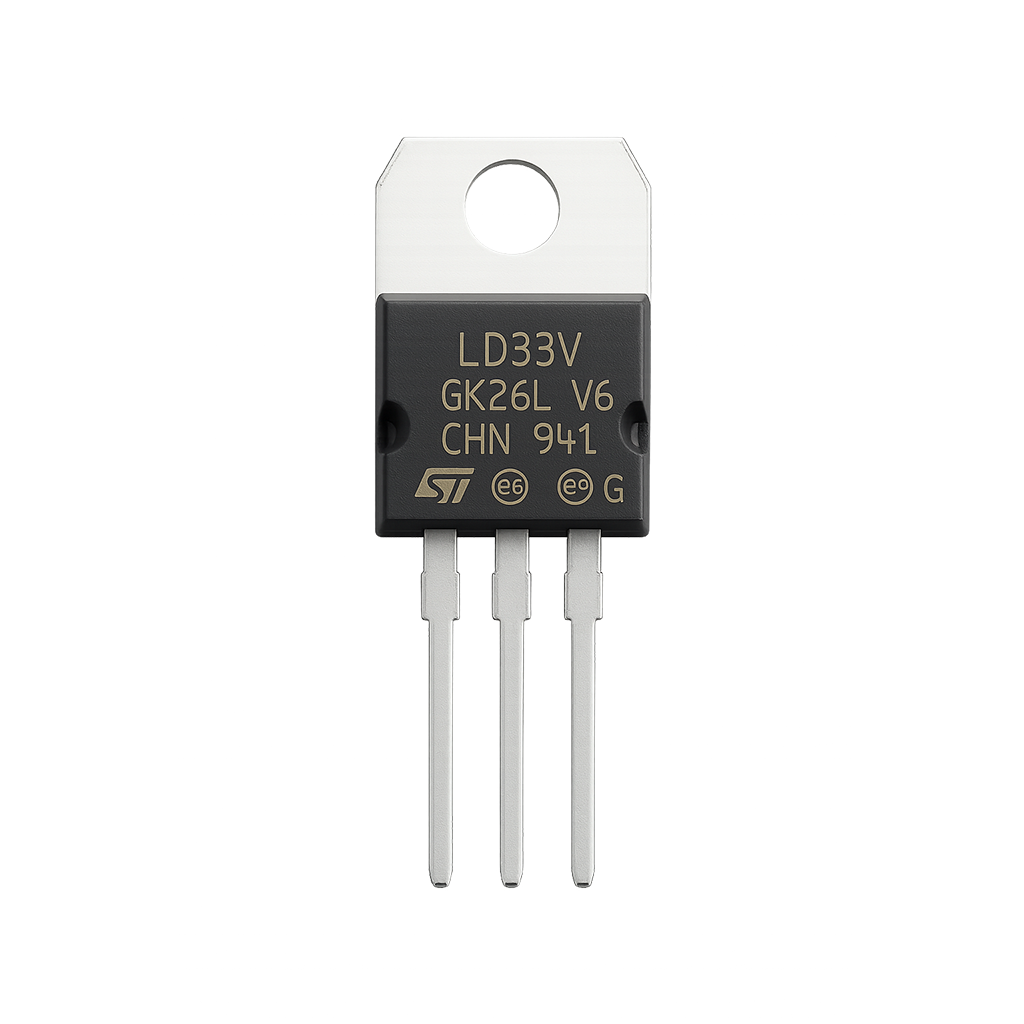
What is the LD33V?
The LD33V is a fixed 3.3 V linear voltage regulator belonging to the LD1117 family. It converts a higher or unstable input voltage into a stable 3.3 V output. Because many microcontrollers, sensors, RF modules, and digital logic cannot operate safely at 5 V, the LD33V is frequently used to power them. Furthermore, its minimal external component requirements and simple three-pin footprint make it ideal for hobby electronics, IoT devices, breadboard prototyping, and compact PCB designs.
Why Choose the LD33V?
✔ Simple to use
Only three pins and no configuration needed.
✔ Clean and stable 3.3 V output
Great for ESP modules, NRF radios, sensors, and anything that requires clean power.
✔ Inexpensive & easy to source
Available everywhere — from hobby shops to professional suppliers.
✔ Good noise/ripple suppression
Important for analog sensors and RF communication.
✔ Multiple package options
TO-220, SOT-223, SMD, breakout boards, etc.
LD33V Variants & Comparison
Different manufacturers offer LD33V or LD1117-3.3 compatible regulators. Here is a quick comparison table:
| Series / Model | Example | Input Voltage | Output Voltage | Max Current | Dropout | Best Use Case |
|---|---|---|---|---|---|---|
| LD33V | Standard LD33V | 4.5–15 V | 3.3 V | 800 mA | ~1.0–1.1 V | General purpose |
| LD1117-3.3 | Pin-compatible | 4.5–15 V | 3.3 V | 800–1000 mA | ~1.1 V | More power margin |
| AMS1117-3.3 | Common alternative | 4.5–12 V | 3.3 V | 800 mA | ~1.2 V | ESP modules, breadboards |
Important: Dropout Voltage
The LD33V requires about 1 V headroom between input and output.
That means:
- Minimum input: 4.3–4.5 V
- Anything below → unstable 3.3 V output
This is not an ultra-low-dropout regulator.
Pinout & Basic Wiring
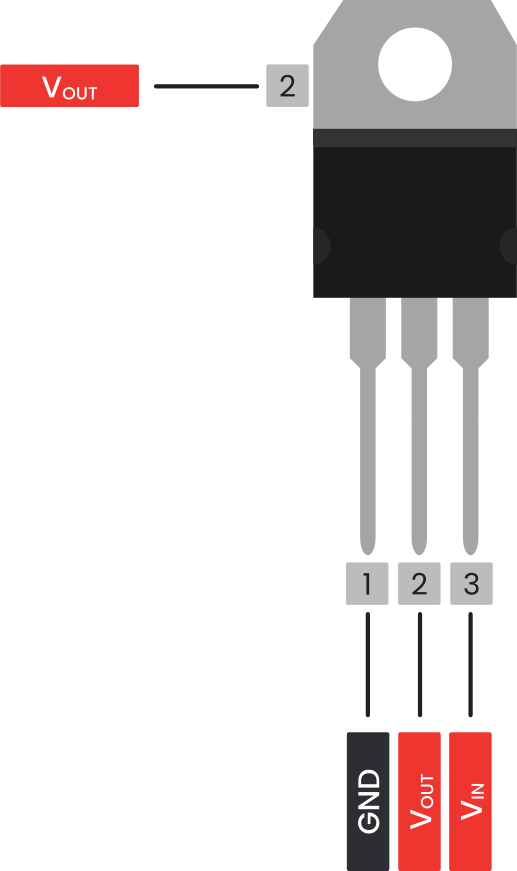
The LD33V has three pins (TO-220, SOT-223 and modules are usually identical):
- Vin – Input voltage (4.5–15 V)
- GND – Ground
- Vout – Regulated 3.3 V output
Required Capacitors
The datasheet strongly recommends:
- 10 µF on Vin
- 10 µF on Vout (preferably low-ESR)
Skipping the capacitors often leads to oscillation or unstable output.
Wiring Diagram
| LD33V Pin | Connect To |
|---|---|
| Vin | 5–12 V input source |
| GND | Ground |
| Vout | 3.3 V rail to your circuit |
| GND | Shared ground with your whole system |
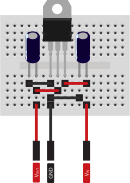
Tip: Always connect all grounds together — the regulator ground must match MCU ground.
Key Specifications Explained
When choosing or using the LD33V, keep the following in mind:
✔ Dropout Voltage (~1.1 V)
A common source of confusion — you cannot feed it with a 3.7 V Li-ion battery and expect 3.3 V output.
✔ Maximum Current (up to 800 mA)
Realistically, thermal limits make it more like:
- 150–300 mA for SOT-223 (no heatsink)
- 400–500 mA before TO-220 gets very hot
✔ Power Dissipation
Linear regulators burn excess voltage as heat.
Formula:
(Vin − Vout) × I = heat
Example:
7 V → 3.3 V @ 300 mA = 1.11 W of heat.
Expect it to be hot to the touch.
✔ Efficiency
Low. For battery-powered devices, a switching regulator is almost always better.
✔ Protections
LD33V includes:
- Overcurrent protection
- Thermal shutdown
- Safe-area protection
Practical Example: Powering an ESP8266 or ESP32 with the LD33V
Many people try to power an ESP module directly from an LD33V — often with mixed results due to WiFi current spikes.
ESP Power Requirements
- Idle: 70–80 mA
- TX peaks: 300–500 mA
Wiring Example
- USB 5 V → LD33V Vin
- GND → GND
- Vout → ESP 3.3 V
- Add 10 µF capacitors on both pins
Common Issues
- Overheating: regulator gets too hot → voltage sag → resets
- Unstable WiFi: 3.3 V drops to 3.1–3.2 V → brownouts
- Insufficient input voltage: especially when USB cables are long
Solutions
- Use a buck converter if Vin > 6 V
- Add a 100 µF buffer capacitor near the ESP
- Short, thick power traces
Things to Watch Out For
- Always use input/output capacitors
- Keep current reasonable (don’t rely on 800 mA unless you have cooling)
- Provide enough input voltage (≥ 4.5 V)
- Avoid using LD33V for battery-powered systems
- Keep the regulator away from heat sources
- Beware of cheap clones with worse dropout performance
Common Mistakes
- Using LD33V with a 3.7 V Li-ion battery → won’t regulate
- Feeding it 12 V and drawing 300 mA → it overheats instantly
- Forgetting capacitors → unstable output / oscillation
- Expecting high efficiency → linear regulators waste power
- Thinking it’s a low-dropout regulator → needs >1 V headroom
Which Version Should You Use?
Here’s a quick guide:
- Quick breadboard or prototyping: LD33V breakout module
- Compact PCB designs: SOT-223 LD33V
- High input voltage or high current: Use a buck converter
- Battery-powered devices: Use a proper LDO (e.g., MCP1700, HT7333)
- Noise-sensitive systems: LD33V is fine with good capacitors
Conclusion
The LD33V remains a simple, dependable voltage regulator for generating clean 3.3 V power. Although it isn’t the most efficient solution, it excels in projects where low noise, simplicity, and reliability matter more than energy savings. By understanding its dropout voltage, thermal behavior, and capacitor requirements, you can take full advantage of what this classic regulator offers.